The October 1997 exhibition at The Milwaukee Art Museum, Identity Crisis read like a thesaurus' answer to the self-portrait, offering a variety of media and forms. The artists involved asked pointed questions about the idea of self. Is the self physical? (Kiki Smith, Jeneane Antoni) Is the self-symbolic? (Catherine Opie) Is the self a product? (Jeff Koons) Identity Crisis was a most fitting title.
I found Nan Goldin's piece to be of particular interest. All By Myself was a slide show installation set to Eartha Kitt's crooning. The images involved depicted Goldin intoxicated, fornicating, crying, healing bleeding, and all through various stages of popular fashion. I was interested less by the images themselves than by the reasoning behind them. Why would anyone want to show themselves to the world in such a raw, vulnerable state?
Goldin's fame comes from her earliest photos of drag queens in their natural environments. These were not taken in a journalistic manner but rather with the same casualness with which I photograph intoxicated guests in my home. It was serendipity that at the time, the transvestite, now almost a passé figure, was still shrouded in taboo. This recognition based on subject (rather than technical skill/manipulation or concept) allowed for Goldin's current work.
Though commonly coined a photographer, Goldin does only the occasional photographic print and has stated that it the slide installations that area truly important to her (lecture, Oct 30 1997 Columbia College). In all of her work, it is Goldin who is the subject, even when she is not in front of the camera. The intimate situations she photographs require intimate relations with the persons involved.
I believe that the ethos of her works can be traced to an occasion in her childhood in which she witnessed the suicide of an older sibling. Her parent's reaction was to convince Goldin that what she had seen did not happen, was not real, forever throwing into question the validity of her personal experience. Her work, the traditional family forum of the sideshow filled with countless grueling images of her every moment, screaming, " This has happened, it is real, I am real," is the adult manifestation of her childhood pathos. By making herself the subject in such a literal manner Goldin is asking us to authenticate that which she can never be sure of, the factuality of her own existence.
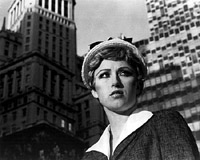
Cindy Sherman's identity crisis is less personal than Goldin's. Her fractioning of self-stems from the mixed messages media sends to women everywhere. Dress and flirt like a tramp but don't be one, learn to support yourself but be ready to give it up at a moments notice to have a family, you must be strong-willed to find a man to be subservient to, etc. One continually wonders which of her fantastic personas is the true Sherman, or perhaps she is an amalgamation of all. Sherman has said, "I divide myself into many different parts. My self in the country... is one part...My professional self is another, myself in the studio is another"(Cindy Sherman, exhibition catalogue, Museum of Modern Art Shiga, Japan 1996).
Cindy Sherman, "Untitled Film Still #21"
Sherman's earliest famed works, the Untitled Film Stills, depict several distinct personas; A young working girl, an emotionally unstable trophy blonde, a pouty dark seductress with broken eggs. As with all of Sherman's works, the situation is implied and the meaning can only be inferred by the viewer, creating the sense of theatricality and self-reflexivity touted as tenets of post-modernism. Sherman confirms and rejects media musing on the role of the woman. The little black dress and dark eyeliner can transform one into a femme fatale, but only if these surface alterations are accepted by the outside as indicative of such. By constantly morphing from one extreme to the next, Sherman forces us to accept the transient state in which these personas exist. She questions the validity of the information assumed by the projective eye. She is the viewed viewing the viewer, both exhibitionist and voyeur. In the style of Goldin, Sherman asks us to authenticate or reject these women, whose very existence is contingent on our response. The viewer's relation to the work is reciprocal.
That an artist's work is always somewhat telling of the person is almost unarguable. As the importance of medium falls to the wayside, and the conceptual goals of the individual become the focus, self as subject develops into an unavoidable part of the art-making process. Whether as confrontational as Goldin, or as clandestine as Sherman, it exists as a necessary part of the post-modernist movement.
The Cindy Sherman Retrospective was on view at the Museum of Contemporary Art, Chicago until May 31, 1998.
More information on Cindy Sherman.